
Researcher Profiles

Eric Pietras, PhD
2026 Funding Recipient
Targeting the nicotinamide pathway in myelodysplastic syndrome
EvansMDS Discovery Research Grant 2026
PROJECT SUMMARY
Despite decades of intense research, myelodysplastic syndrome (MDS) is still a largely incurable disease. Patient outcomes are often poor, with only ~30% of patients responding to current drugs. In addition, no new treatments have been shown in clinical trials to improve the survival of MDS patients since 2009. Better options are needed if we are to improve the lives of MDS patients.
One way that we have worked to find better treatments is to find drugs that can specifically kill the MDS “stem cell” population that serve as the ‘root’ of the disease. In healthy blood systems, the blood-forming stem cells are a small and long-lasting population of specialized cells that live in the bone marrow (BM). These stem cells are tasked with continually producing new red and white blood cells to replace worn-out ones over the course of an entire lifetime. Like normal blood-forming stem cells, MDS stem cells also live in the bone marrow (BM). However, unlike normal blood stem cells, MDS stem cells contain gene mutations that prevent them from making new blood cells. The gene mutations in MDS stem cells not only cause disease but often also cause the MDS stem cells to become resistant to the drugs we use to treat MDS, leading to treatment resistance and disease progression. With this in mind, we have carefully studied MDS stem cells from BM donated by MDS patients to learn how they are different from normal, healthy blood stem cells. This strategy has allowed us to find drugs that target these differences, allowing us to kill the MDS stem cells. Our studies have shown that MDS stem cells use high levels of energy to make proteins, the building blocks that cells need to grow and produce new copies of themselves. We used this information to find a drug that could block the ability of MDS stem cells to make new proteins. The clinical trial we ran using this drug was better at killing the MDS stem cells but also had some toxic side effects that make prolonged use of the drug challenging, especially for older patients.
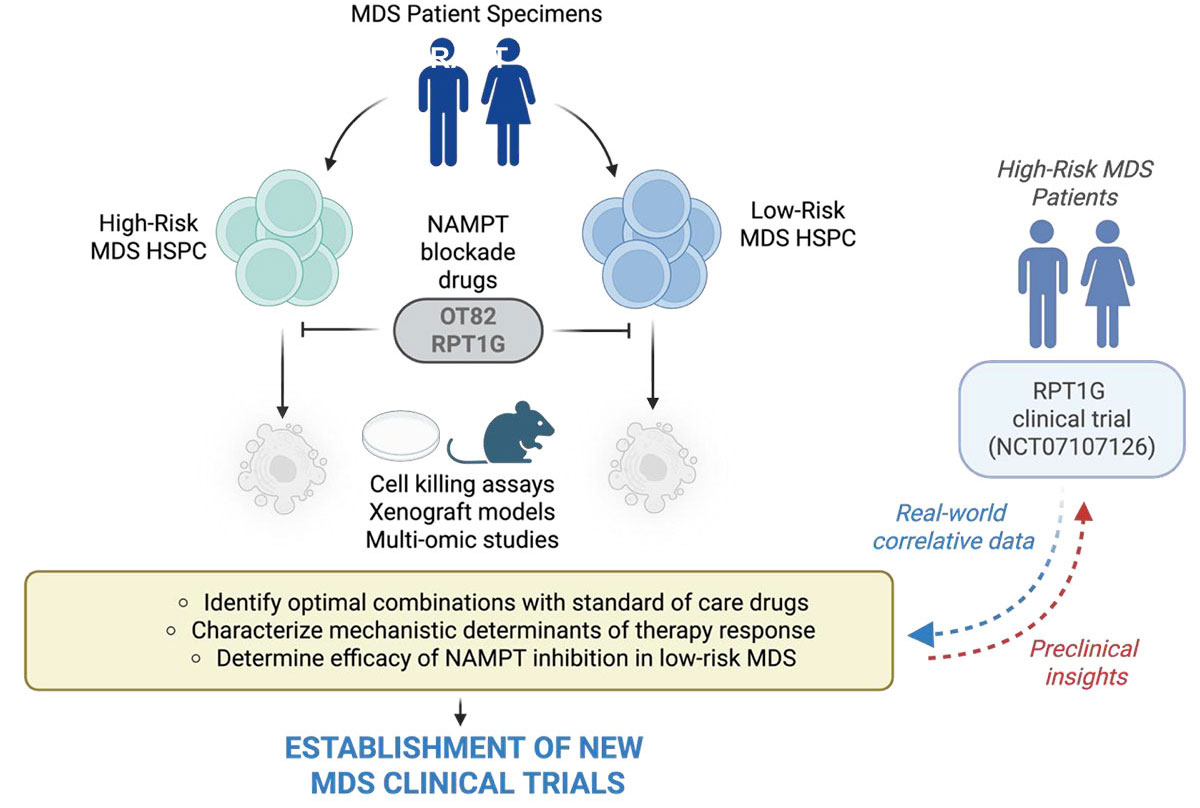
Since then, we have used specimens donated by our patients, including the clinical trial described above, to better understand how MDS stem cells are able to produce the high levels of energy they need for making new proteins. In doing so, we found that MDS stem cells need to produce a natural chemical compound called NAD, to maintain their high energy levels. We have since found two drugs that can block the production of NAD by MDS stem cells and have been able to show that these drugs can preferentially kill MDS stem cells while sparing normal blood stem cells. We believe these drugs, both of which are already undergoing clinical investigation, will have significant potential as treatments for MDS.
The primary goal of our project is to learn how best to use these drugs in patients, either alone or in combination with currently available therapies, and to identify whether they may work better than current drugs in treating particularly challenging types of MDS with specific gene mutations. We are also examining whether these drugs can be used as a preventative measure in patients who have early stages of MDS to slow or stop progression to more serious forms of disease. Altogether, the aim of our project is to support the development of clinical trials using these drugs to improve MDS patient outcomes.