
Researcher Profiles

Peter Miller, MD, PhD
Massachusetts General Hospital
2026 Funding Recipient
Telomere Dysfunction as a Driver of DDR-Mutant Clonal Evolution in MDS
EvansMDS Discovery Research Grant 2026
PROJECT SUMMARY
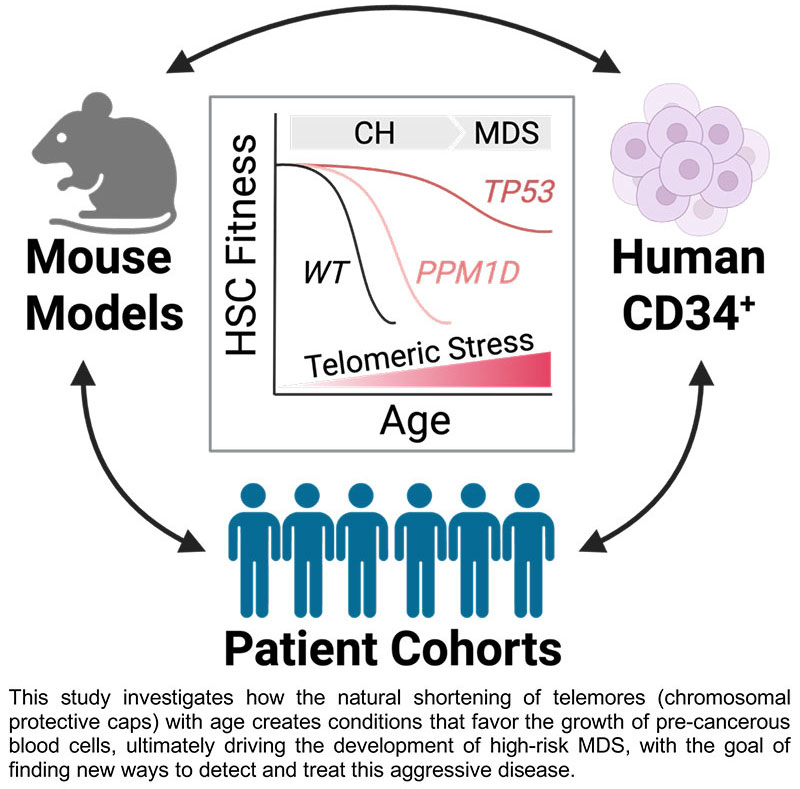
Myelodysplastic syndromes (MDS) are blood diseases where the bone marrow fails to produce enough healthy blood cells. Some patients have mutations in protective genes, especially TP53 and PPM1D, that cause poor outcomes and treatment resistance. We aim to understand why these mutations arise and how they help abnormal cells take over the bone marrow.
Each time a cell divides, the protective caps on chromosomes, called telomeres, get shorter. As we age, blood stem cells accumulate this wear until critically short telomeres trigger stress signals that normally shut damaged cells down. If a cell also carries a TP53 or PPM1D mutation, it can ignore these signals and keep growing, gaining an unfair advantage over healthy cells and potentially driving MDS.
Our project has two goals. First, we will test whether short telomeres and these mutations cooperate to promote abnormal cell growth, using mice with short telomeres and human blood stem cells with gene-editing to introduce mutations. Second, we will define the internal signals that allow mutant cells to override “stop growing” commands under stress. We will also analyze blood samples from hundreds of MDS patients and healthy individuals to determine whether shorter telomeres predict the presence of these dangerous mutations.
By revealing how short telomeres and broken protective genes drive MDS together, we hope to identify new risk stratification and treatment strategies for this hard-to-treat disease.