
Researcher Profiles

Timothy Ley, MD
Washington University in St. Louis
2026 Funding Recipient
mRNA-mediated restoration of TP53 function in TP53 mutant MDS cells
EvansMDS Discovery Research Grant 2026
PROJECT SUMMARY
Myelodysplastic syndrome (MDS) is a blood cell cancer diagnosed in at least 20,000 people per year in the US. The average age of onset is about 70 years. Most people present with symptoms related to low blood counts (e.g. fatigue from anemia, bleeding from low platelets, or infections due to altered function of white blood cells). Although some people with MDS can have relatively mild courses, about 10% of patients have a very high risk of rapid progression to acute myeloid leukemia (AML), and unfavorable outcomes. Many of these high-risk patients can be identified by the sequencing of genes associated with MDS, which is now routinely performed when patients are first seen. Mutations in one particular gene, called TP53, are strongly associated with this high-risk form of MDS; many of these mutations are thought to reduce the function of the TP53 protein, which can allow blood stem cells to survive and grow under circumstances when they should normally die (as a consequence of normal TP53 activity, which guards cells against mutations that can cause cancer).
Patients who have MDS or AML with TP53 mutations are usually refractory to standard forms of chemotherapy and often die from their disease within a year of diagnosis. Although stem cell transplantation is attempted for some of these patients, it is rarely curative. Because MDS and AML patients with TP53 mutations do so poorly with standard-of-care treatments, this diagnosis represents an important unmet clinical need.
During the past 15 years, our group and others have defined nearly all of the mutations that are important for the development of MDS and AML; although these studies have greatly advanced our understanding of the genetic underpinnings of this disease, we have not yet fully exploited this information to create novel approaches for precision therapies. We now know that MDS and AML can be initiated by “loss-of-function” mutations, which reduce or eliminate the function of genes that are important for normal blood cell development; indeed, many mutations in TP53 cause loss of its function. In the past, correcting loss-of-function mutations in cancer cells with “gene therapy” has essentially been impossible, for a variety of reasons. However, with the advent of new approaches for making messenger RNAs (mRNAs) for vaccines (like the mRNA vaccines for COVID-19), a new
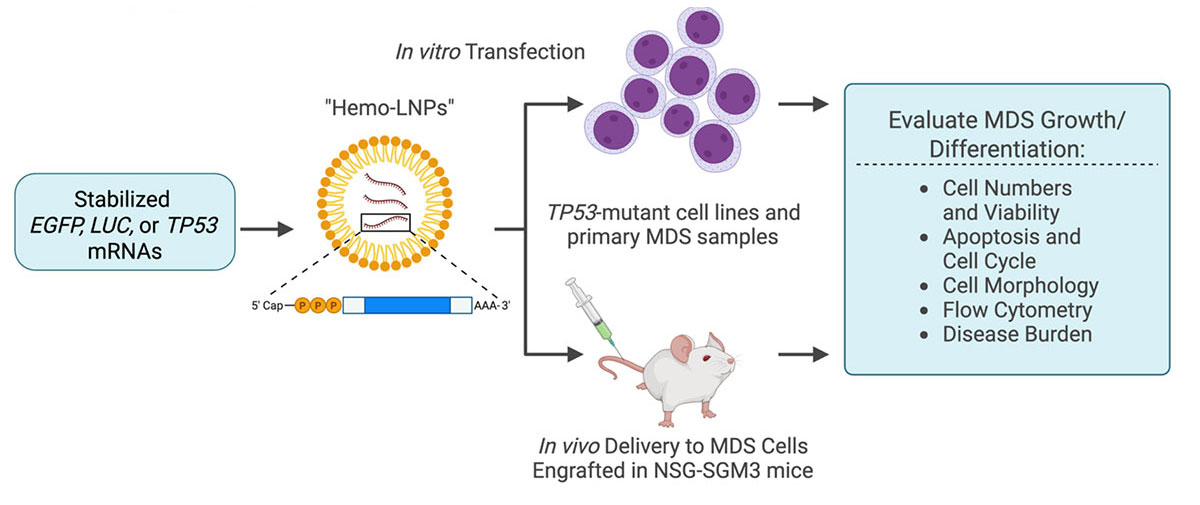
possibility exists for restoring TP53 function in MDS cells. “Therapeutic mRNAs” (containing modifications that make them more stable and less likely to cause immune responses) can now be rapidly and efficiently produced in any molecular biology lab. We have recently developed a unique system to deliver stabilized mRNAs directly into MDS cells, using tiny synthetic fat droplets called lipid nanoparticles, which can deliver encapsulated TP53 mRNA to the interior of MDS cells, where the mRNA is translated into TP53 protein. This approach will allow us to determine whether restoration of normal TP53 function can reduce the growth of TP53 mutant MDS cells growing in tissue culture media, or in mice.
This grant will provide the support needed to overcome the many obstacles needed to make this approach possible. First, we will have to determine which MDS cases could potentially be corrected by TP53 mRNA addback. Since there are hundreds of different TP53 mutations associated with MDS, we must first define the ones that are correctable, since patients with these mutations would be the most likely to respond to mRNA therapy. Secondly, we will have to determine how best to deliver the lipid nanoparticles directly to MDS cells within a living organism, which we will test in mice. Finally, we will use our optimized methods to treat mice containing human MDS cells with TP53 mutations, in an attempt to eliminate these cells from the mice (“preclinical testing”). If successful, these studies will define a new approach for treating patients with high-risk, TP53 mutant MDS.