
Researcher Profiles

Grant Challen, PhD
Washington University in St. Louis
2026 Funding Recipient
Mechanisms of Telomerase Inhibition Sensitivity in MDS
EvansMDS Discovery Research Grant 2026
PROJECT SUMMARY
Myelodysplastic syndromes (MDS) are diseases that lower production of normal blood cells. MDS is considered a type of cancer. There are only four approved drugs for MDS patients, but these do not cure the disease. We need new ways to care for MDS patients. Hematopoietic stem cells (HSCs) in our bone marrow are responsible for life-long generation of blood. HSCs get genetic mutations as we age. Most mutations have no effects, but sometimes they affect the HSC so the cell grows faster. This is called clonal hematopoiesis (CH). People with CH have a higher chance of developing MDS. Our lab studies how these mutations lead to CH and how MDS develops.
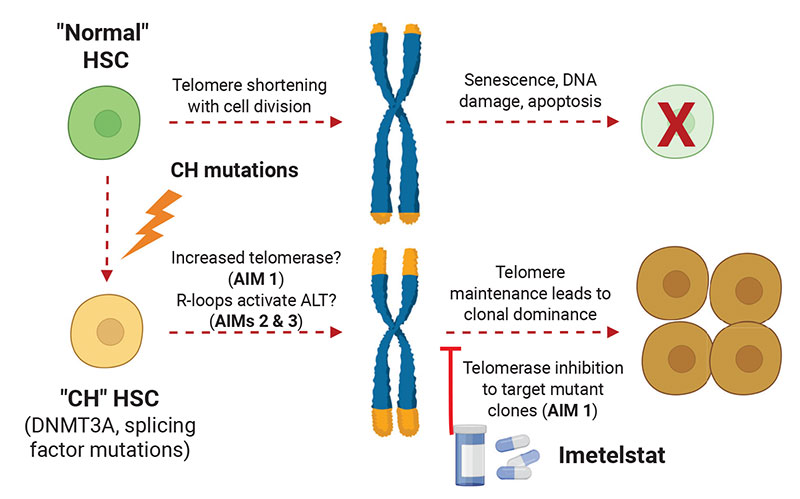
The most mutated gene in CH is called DNMT3A, which is also mutated in many MDS patients. We found these mutations extend the lifespan of HSCs. Normally, HSCs have restrictions that limit their lifespan called telomeres. Telomeres are caps at the end of chromosomes that protect them. But when telomeres become short, HSCs die or become dormant. We found that HSCs with mutations in DNMT3A overcome telomere shortening. This appears to be one of the first steps to development of MDS. This is an exciting finding because it presents a new treatment for these patients. There is a drug that inhibits the enzyme that extends telomeres. The goal of this study is to determine if this drug can specifically inhibit the function of cells with DNMT3A mutations. We hope our experiments will allow more MDS patients to benefit from this new therapy.