

EvansMDS iPSC Initiative
Creating a resource to promote collaboration within the EvansMDS research community.
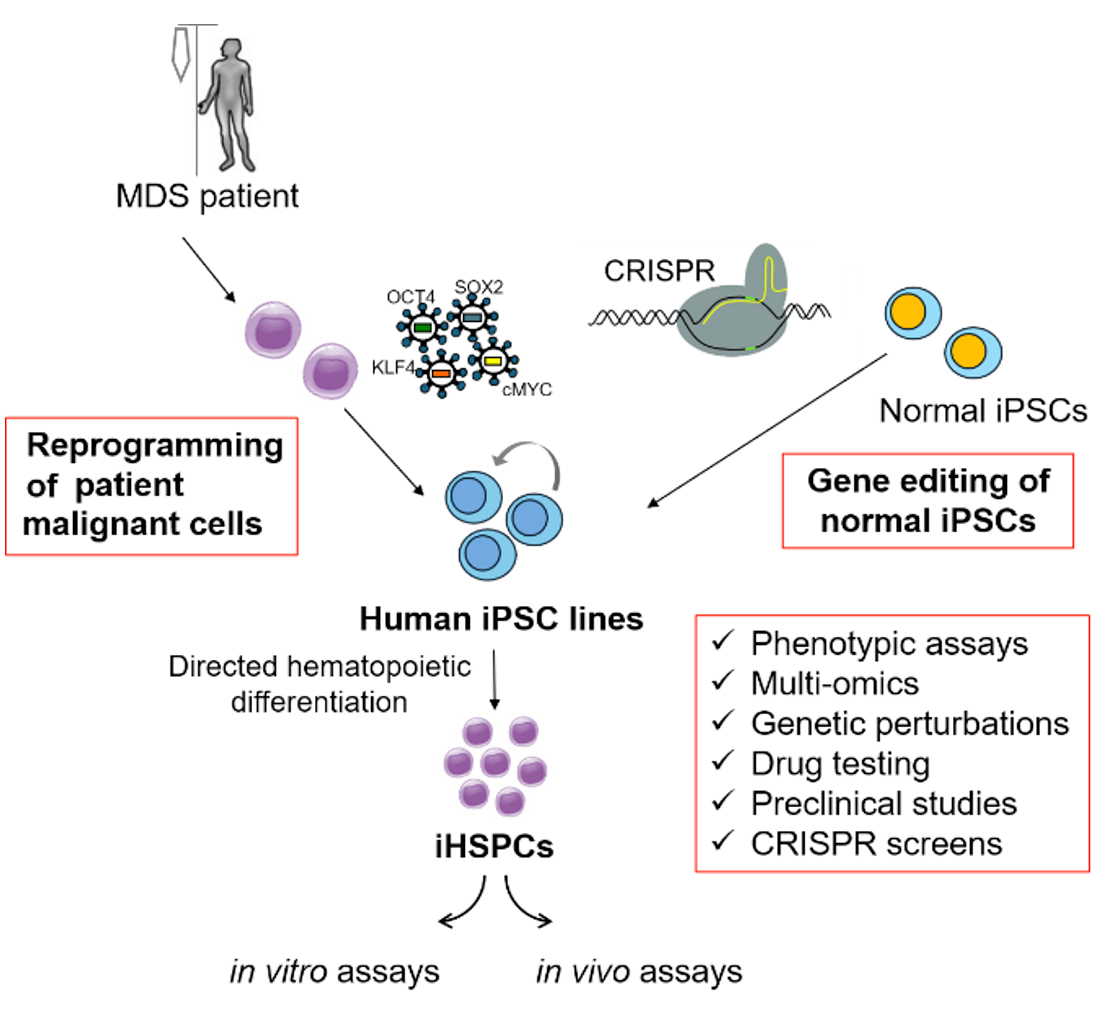 Induced pluripotent stem cell (iPSC) technology has made it feasible to create clonal lines capturing key MDS-associated mutations and isogenic wildtype controls. iPSC lines may be created by either direct reprogramming of patient-derived material, or by editing normal iPSC lines to introduce specific mutations. A key breakthrough, led by the Elefanty group (PMID 39223325), allows for robust differentiation of iPSC lines into multilineage, engraftable hematopoietic stem/progenitor cells (iHSPCs) that are suitable for a variety of downstream applications..
The Edward P. Evans Foundation has funded the creation of a human iPSC repository based at the Mount Sinai School of Medicine under the direction of Dr. Eirini Papapetrou. Requests for generation of iPSC lines, distribution of existing iPSC lines, or distribution of differentiated progeny from existing iPSC lines may be made using the forms below. All requests are subject to feasibility, scientific review, and approval, and must adhere to the terms provided in the forms. Material Transfer Agreement (MTA) templates are also provided; one for legacy (previously generated) iPSC lines, and another for new lines generated in collaboration with the Edward P. Evans Foundation. Eligible requesting parties must be faculty members at US institutions and must agree to use the requested material solely for non-commercial and academic research purposes. Preference will be given to requesting parties with a track record of funding from the Edward P. Evans Foundation.
Resources:
- Existing iPSC inventory
- Request for existing iPSC lines
- Request to generate novel iPSC lines from patient material
- Request to generate novel iPSC lines by gene editing
- Request for differentiated hematopoietic cells from existing iPSC lines
- Mount Sinai Material Transfer Agreement (MTA) form (for Legacy lines)
- Mount Sinai Material Transfer Agreement (MTA) form (for EPEF lines)